

When most of us imagine the nervous system, we often picture something like an intricate electrical network: a series of wires transmitting information from the brain to the rest of the body and back again.
While this metaphor is useful, it is also incomplete.
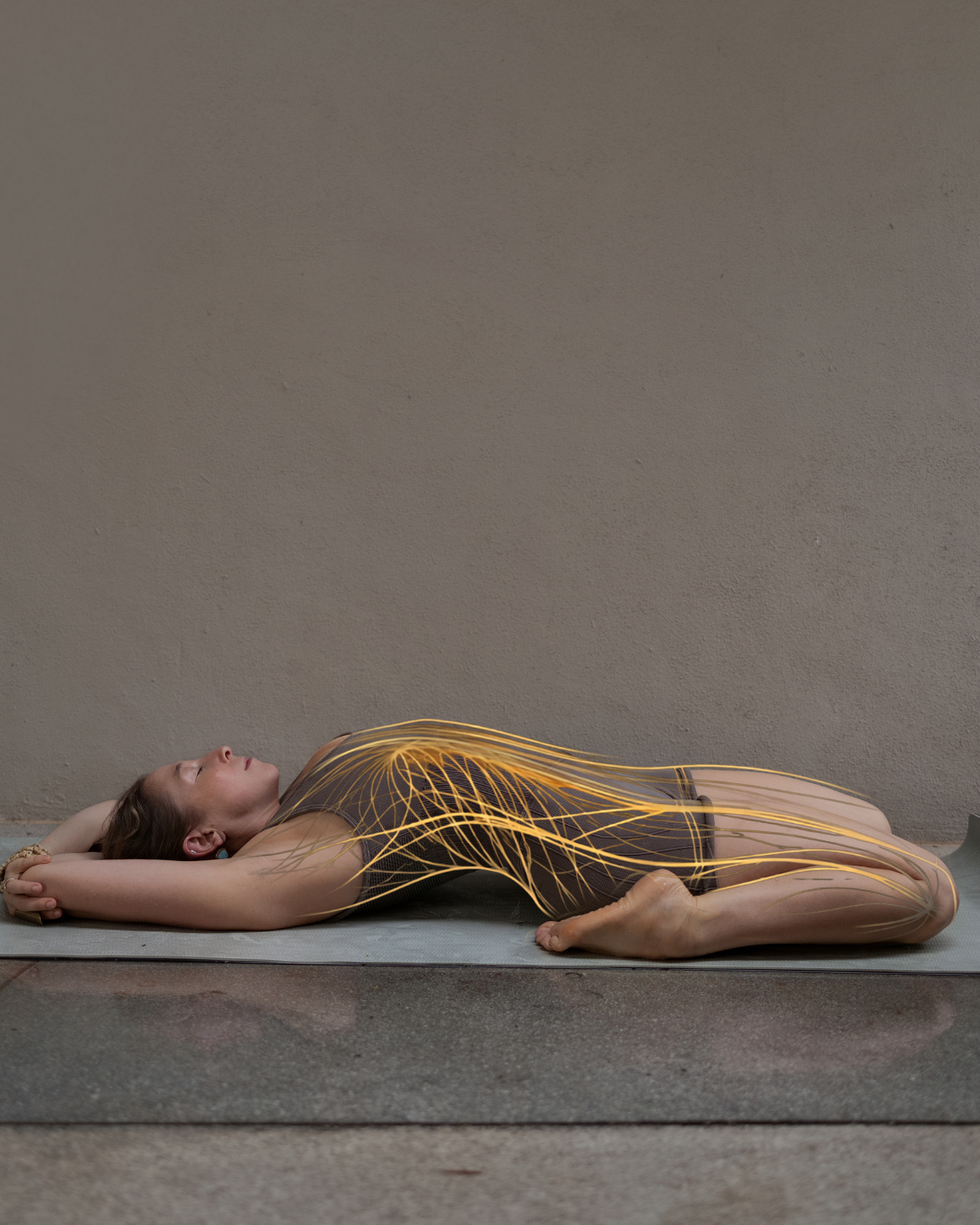
The nervous system does not exist in isolation. It is not suspended in empty space, separate from the tissues, fluids, and structures that surround it. Every nerve pathway in the body exists within a living landscape of connective tissue — a dynamic, responsive matrix known as fascia.
To understand the nervous system, we have to understand the body it lives within.
Fascia is often described as the body’s connective tissue system. It surrounds and interweaves through muscles, bones, organs, blood vessels, and nerves, creating a continuous web throughout the entire body. What was once dismissed as simply “packing material” between structures is now understood as a highly responsive sensory and mechanical system — one that plays a role in movement, proprioception, and our felt experience of being alive inside a body.
The body is not a collection of separate parts stitched together.
It is an interconnected landscape.
The Fascial Environment of the Nervous System
Every nerve in the body is surrounded by layers of connective tissue that provide both protection and mobility. These fascial coverings allow nerves to glide, slide, and adapt as we move through space.
Consider the sciatic nerve traveling from the low back through the pelvis and down the leg. With every step, every bend, every change in posture, this nerve is moving within a complex environment of muscles, fascia, and fluid. The health of that environment influences how easily the nerve can adapt to movement and changing demands.
A healthy nervous system is not only about the signals being sent.
It is also about the landscape those signals are moving through.
Like a river flowing through a valley, a nerve requires both containment and freedom. It needs structure, but it also needs the capacity to move.
This is one reason why practices that cultivate mobility, hydration, and awareness within the fascial system can be so valuable. We are not simply changing a muscle. We are interacting with an entire sensory network.
Fascia: A Sensory Organ
One of the most fascinating discoveries about fascia is that it is not merely structural. It is deeply sensory.
Fascial tissues contain a rich network of mechanoreceptors and sensory nerve endings that communicate information about pressure, tension, movement, and position. This information contributes to proprioception — our ability to know where we are in space — as well as interoception, our ability to sense what is happening within ourselves.
This is one reason why slow, mindful movement can feel so profoundly different from movement that is purely goal-oriented.
When we slow down enough to listen, we begin receiving information that is often drowned out by the pace of modern life.
The subtle pulling sensation along a fascial line.
The feeling of expansion after a breath.
The moment when tension softens without force.
The awareness of where we habitually brace or protect.
The body begins speaking in a language that is not conceptual, but experiential.
Why Yin Yoga Is a Fascial Practice
This is where Yin yoga offers a unique doorway.
In a culture that often approaches the body through achievement — how far can I stretch, how strong can I become, how much can I accomplish — Yin invites another relationship.
Rather than imposing ourselves upon the body, we practice listening to it.
Longer-held postures create an opportunity to explore the qualities of sensation and adaptation. We are not trying to aggressively stretch fascia or force tissues to change. The body is far more intelligent than that.
Instead, we are creating conditions for awareness.
We are giving the nervous system new sensory experiences.
We are allowing the relationship between breath, sensation, attention, and tissue to become more conscious.
The practice becomes less about conquering the body and more about developing a relationship with the body’s intelligence.
From Mechanical Body to Living Body
Perhaps one of the greatest misunderstandings of anatomy is that learning about the body should make us feel separate from it.
We study the muscles.
We memorize the bones.
We name the structures.
And yet the deeper invitation of embodied anatomy is not to objectify the body, but to become more intimate with it.
The fascia reminds us that we are not assembled from isolated pieces. We are an interconnected, adaptive organism constantly communicating with itself.
The nervous system is not just sending messages through the body.
It is listening through the body.
Every sensation is information.
Every movement is communication.
Every breath is an opportunity to participate in this ongoing conversation.
Building Nervous System Resilience Through Embodied Awareness
Resilience does not mean the absence of stress, tension, or challenge.
A resilient system is not one that never experiences pressure. It is one that can respond, adapt, and return.
This is the wisdom we see throughout nature. A tree that can withstand the wind is not a tree that is rigid. It is a tree with the capacity to move.
The same is true within us.
Through mindful movement, breath, and embodied practices, we cultivate our capacity to meet sensation without immediately contracting against it. We learn to notice patterns of holding. We learn to create space where there was once only tension.
We begin to inhabit the body not as something we manage from the outside, but as a living intelligence we participate in from within.
The nervous system lives in a fascial body.