
The Complete Guide to the Five Elements in Chinese Medicine
Every spring, without consulting a calendar, the tulips begin pushing through frozen ground.
By midsummer, cottonwoods cast generous shade over rivers swollen with snowmelt. Autumn arrives not as a date but as a subtle shift in light, when leaves loosen their grip and the air grows impossibly clear. Winter follows with its invitation toward stillness, asking roots to deepen while the visible world appears to rest.
Nature has never been static.
She moves in cycles.
Long before modern biology described ecosystems or circadian rhythms, Chinese Medicine observed these same movements with astonishing precision. Physicians, philosophers, and contemplatives recognized that human beings are not separate from the natural world but expressions of it. The body was understood not as a machine composed of isolated parts, but as a living landscape participating in the same rhythms that govern forests, rivers, weather, and stars.
This observation gave rise to one of the foundational frameworks of Traditional Chinese Medicine: the Five Elements.
More accurately translated as the Five Phases or Five Movements (Wu Xing), these are not elements in the Western sense of physical substances. Wood, Fire, Earth, Metal, and Water are not things the body contains. They are dynamic patterns of transformation. They describe the ways life continually unfolds, expands, matures, releases, and returns. They map not only the seasons of the external world, but the seasons of a single day, a human lifespan, an emotion, a relationship, or even a single breath.
To study the Five Elements is therefore to study change itself.
It is to recognize that health is not the absence of symptoms but the capacity to move fluidly through life's continual cycles without becoming fixed in any one of them.
This is perhaps where Chinese Medicine feels most radically different from the modern Western imagination. Contemporary medicine often asks, "What disease is present?" Classical Chinese Medicine begins with another question altogether: "What pattern is unfolding?"
Rather than viewing anxiety, insomnia, digestive distress, grief, or fatigue as isolated problems to eliminate, the Five Elements invite us to ask how the whole ecosystem of the body has fallen out of relationship. Which season has become excessive? Which movement has weakened? Where has life ceased flowing as nature intended?
The answers are rarely linear because nature herself is not linear.
Walk into an old-growth forest and you will not find perfect symmetry. There are fallen trees nourishing seedlings, rivers carving new paths, moss growing where sunlight has diminished, decay feeding future abundance. What appears chaotic from one perspective reveals extraordinary intelligence from another. The human body operates much the same way.
Each of the Five Elements expresses a particular quality of life.
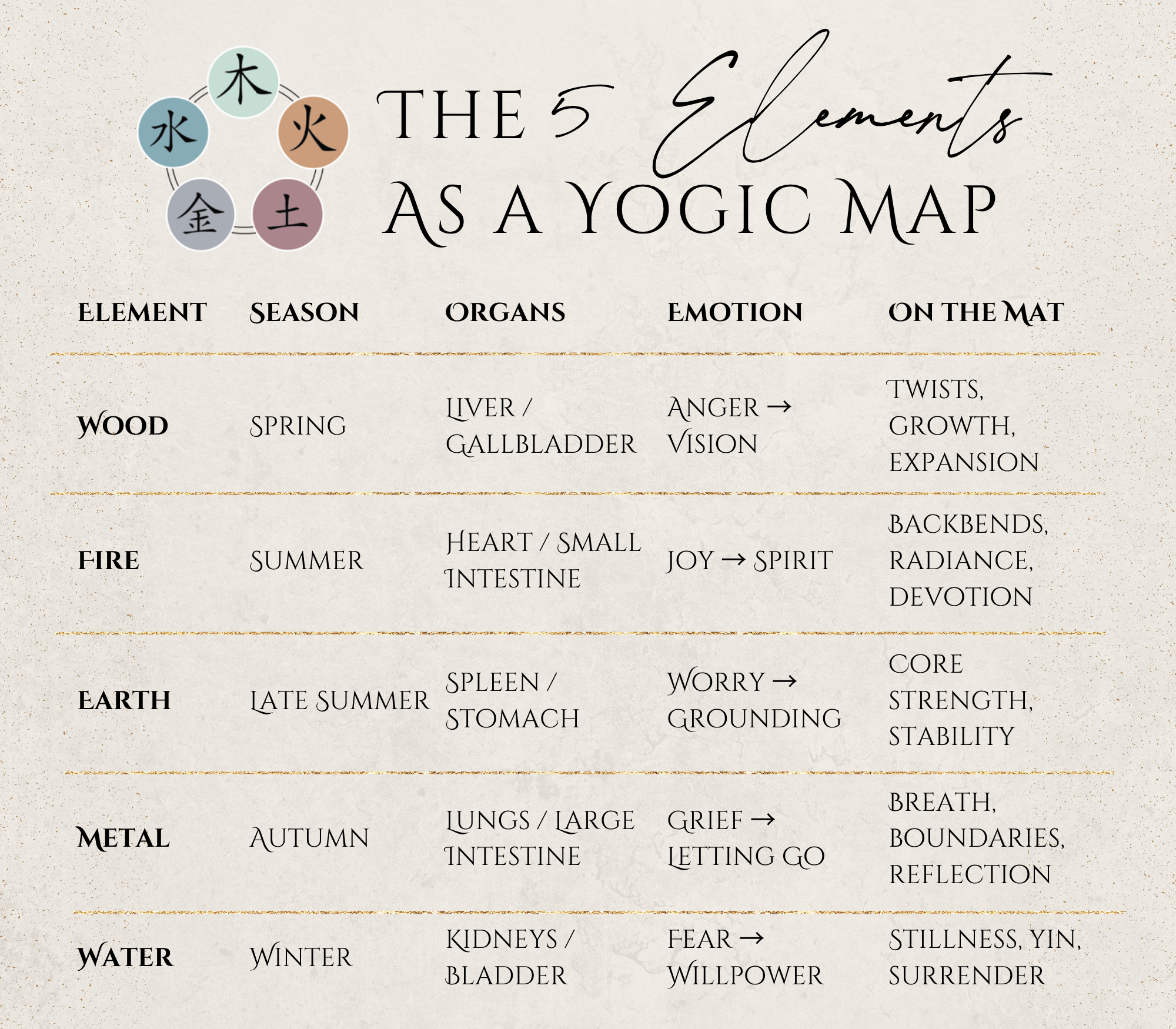
Wood belongs to spring, to germination, vision, direction, and the tremendous force required for something unseen to break through the surface of the earth. Within the body it governs the Liver and Gallbladder meridians, influencing not only tendons and fascia but our capacity to adapt, create, and move forward. Healthy Wood is flexible, like a young branch bending with the wind. When constrained, it often expresses itself through frustration, rigidity, resentment, or the sensation that life has become somehow stuck.
Fire arrives with summer, when life reaches outward toward connection and expression. Governed by the Heart and Small Intestine, Fire illuminates consciousness itself. Classical Chinese Medicine teaches that the Heart houses the Shen—our luminous spirit, the quality of awareness that allows us to experience joy, intimacy, and genuine presence. Healthy Fire radiates warmth without consuming itself. It knows how to shine without burning.
Earth emerges as late summer, the quiet season of harvest and nourishment. It is the fertile ground that transforms what has been gathered into what can sustain life. Associated with the Spleen and Stomach, Earth governs digestion in every sense of the word—not merely our ability to assimilate food, but to metabolize experience itself. People with balanced Earth often possess a remarkable capacity to make others feel at home because they themselves know how to inhabit the ground beneath their feet.
Metal belongs to autumn, the season that teaches the sacred art of letting go. Leaves release their branches. Breath leaves the lungs. What has completed its life cycle returns to the soil so something new may eventually emerge. Through the Lungs and Large Intestine, Metal governs both respiration and release, inviting discernment about what must be cherished and what can no longer be carried. Healthy Metal understands that grief and gratitude often arise from the same open heart.
Water carries us into winter, the season modern culture most resists. While productivity asks us to continue expanding indefinitely, nature insists upon another rhythm entirely. Seeds disappear underground. Rivers slow. Animals retreat. The Kidneys and Bladder, governed by Water, preserve our deepest reserves of vitality and remind us that restoration is not the opposite of growth but the very condition that makes growth possible. Healthy Water trusts the unseen. It understands that much of life is quietly ripening beneath the surface long before it becomes visible.
Although each element possesses its own qualities, none exists independently. Wood feeds Fire. Fire creates Earth through ash. Earth bears Metal. Metal enriches Water. Water nourishes Wood. Health arises not because one element dominates the others, but because each participates in an ongoing conversation of mutual support and transformation. Just as no ecosystem can flourish through endless spring or perpetual summer, neither can a human life remain healthy by inhabiting only one season of being.
This is why the Five Elements continue to feel so profoundly relevant. They offer something increasingly rare in modern life: a framework that honors rhythm over optimization, relationship over reductionism, and participation over control. They remind us that we are not machines requiring repair but living landscapes continually adapting to the changing conditions of existence.
For me, the Five Elements have never been simply a system of medicine. They have become a way of seeing. A language for understanding why certain seasons of life ask for courage while others ask for surrender, why grief and joy can coexist in the same heart, and why healing so often resembles a forest more than a factory. We are not here to remain permanently in bloom. We are here to learn the wisdom of every season, trusting that each carries its own medicine and that, beneath all the visible changes, life is quietly weaving us back into wholeness.